
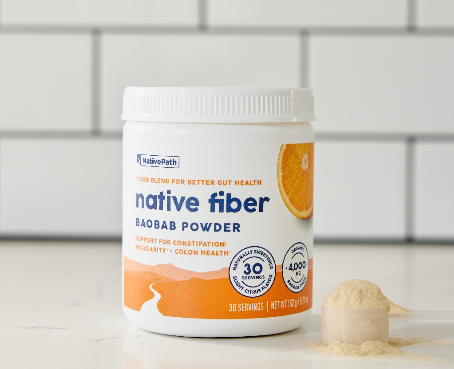
Let me be honest with you right from the start. I did not wake up one morning excited to write a NativePath Fiber review. I woke up bloated. Again. For most of last year, my digestion was the quiet background problem I kept promising myself I would fix “next week.” I was irregular, gassy after almost every meal, and permanently uncomfortable in my own jeans by 3 p.m.
Like 95% of Americans, I simply wasn’t getting enough fiber. I knew it, my doctor knew it, and my abandoned bag of chalky psyllium husk in the back of the pantry definitely knew it. So when I kept seeing NativePath Fiber reviews pop up in my feeds, praising this orange-flavored baobab powder as a gentler, better-tasting alternative to the usual suspects, I was skeptical but curious enough to order it.
Sixty days later, I have opinions. Strong ones. In this in-depth review, I’ll walk you through exactly what Native Path Fiber is, what’s inside it, how it works, who it’s for, how it stacks up against Metamucil and psyllium, and, most importantly, whether Native Fiber actually works. If you’ve been typing “is Native Path Fiber good” into Google at 2 a.m. while your stomach gurgles in protest, this one’s for you.

What Is NativePath Fiber?
NativePath Fiber (also sold as Native Fiber by NativePath) is a daily fiber supplement powder built around a single star ingredient: organic baobab fruit powder. If you’ve never heard of baobab, you’re not alone. It comes from the baobab tree, often called “the tree of life,” which grows in Africa, Australia, and the Middle East. The fruit has a genuinely unusual quirk: it dries naturally on the branch inside its hard shell, so the pulp can simply be ground into powder without heating, pasteurization, or chemical processing. Consequently, its nutrients arrive in the jar essentially intact.
What makes baobab special as a fiber source is balance. Most fiber supplements give you either soluble fiber or insoluble fiber. Baobab is one of the very few natural whole foods that delivers meaningful amounts of both forms at once, and roughly half of the fruit pulp is dietary fiber. On top of that, NativePath adds 200mg of L-glutamine per serving, an amino acid studied for its role in supporting the gut lining and microbiome.
The result is a tangy, citrus-flavored powder you stir into water, smoothies, yogurt, or tea once to three times a day. No capsules to choke down, no gluey psyllium texture, no artificial anything. That, in a nutshell, is the pitch. In my experience, the reality mostly lives up to it, though there are a few caveats I’ll get into later.
Click Here to Buy NativePath Fiber
Specifications of NativePath Fiber
Before we get into how it felt to actually use, here are the hard facts about this Native Path Fiber supplement, straight from the label and the official product page:
- Product name: Native Fiber by NativePath (NativePath Fiber baobab powder)
- Form: Loose powder, mixed into liquid
- Primary ingredient: Organic baobab fruit powder
- Fiber per scoop: 4 grams of balanced soluble and insoluble fiber
- Added gut support: 200mg of L-glutamine per serving
- Servings per jar: 30 servings
- Flavor: Natural tangy orange/citrus
- Free from: Artificial ingredients, sweeteners, added sugar, preservatives, fillers, gluten, and GMOs
- Manufacturing: Small batch, sustainably sourced, GMP-certified facilities, third-party tested
- Retail price: $45 per jar, with bundle pricing down to $21 per jar on 6-jar packages (roughly 53% off at the time of writing)
- Extras on bundle orders: Free shipping on U.S. orders and a free frother for mixing
- Guarantee: 365-day money-back guarantee
- Suggested use: 1 to 2 servings daily (up to 3 with meals), morning or night
Notice something? The transparency here is refreshingly simple. There’s no proprietary blend hiding a dozen mystery ingredients. The Native Path Fiber ingredients list is essentially baobab plus L-glutamine, and that’s it.
Features of NativePath Fiber
Specs are one thing. What those specs feel like in daily life is another. After two months of daily use, these are the features of this NativePath fiber supplement that genuinely mattered to me.
Dual-Fiber Baobab Base
This is the headline feature, and honestly, it’s the reason I chose Native Path Fiber baobab powder over yet another tub of psyllium. Soluble fiber forms a gel that supports healthy cholesterol, steadier blood sugar, and longer-lasting fullness. Insoluble fiber, meanwhile, adds bulk and keeps everything moving through the digestive tract. Because baobab naturally contains both, one scoop covers two jobs. In practical terms, I stopped alternating between different products to get “complete” fiber coverage.
Added L-Glutamine for Gut Lining Support
Most budget fiber powders stop at fiber. NativePath baobab fiber goes one step further with 200mg of L-glutamine, an amino acid that research suggests helps balance the gut microbiome, supports the tight junction proteins in the intestinal lining, and helps regulate gut inflammation. Is 200mg a mega-dose? No. But as a daily top-up alongside the prebiotic fiber, it’s a thoughtful addition I haven’t seen in comparable products.
It Actually Tastes Good
I cannot overstate this. My biggest failure with fiber supplements in the past was compliance. I’d buy them, hate them, and quit by day nine. Native Fiber tastes like a lightly tangy orange drink. It dissolves quickly, doesn’t clump, doesn’t turn to sludge if you leave it for five minutes, and leaves no gritty aftertaste. Surprisingly, it became something I looked forward to in the mornings, which is precisely why I actually stayed consistent for 60 days.
Naturally Nutrient-Dense
Because baobab is a whole fruit powder rather than an isolated fiber extract, every scoop also carries vitamin C, B vitamins, potassium, magnesium, calcium, iron, antioxidants, and polyphenols. According to the product’s own comparisons, baobab contains several times more vitamin C than oranges by weight and more antioxidants than blueberries or acai. You’re not just buying fiber; you’re buying a micronutrient boost.
Clean Label and Serious Guarantee
No sugar, no sweeteners, no fillers, no gluten, no GMOs, third-party tested, and backed by a full 365-day money-back guarantee. Furthermore, there’s no forced subscription. That guarantee did a lot of heavy lifting in my decision to try it, because a year-long refund window signals a company that expects people to keep the product.
Click Here to Buy NativePath Fiber
How NativePath Fiber Works
So how does Native Fiber work once it’s actually in your body? Here’s the simple, step-by-step version.
- You mix and drink it. One scoop into water, a smoothie, tea, or yogurt. The powder dissolves fast, so this takes about 20 seconds.
- Soluble fiber gets to work first. In your stomach and small intestine, the soluble fiber absorbs water and forms a soft gel. This slows the absorption of carbohydrates from your meal, which supports steadier blood sugar and helps you feel full for longer. Consequently, cravings tend to quiet down.
- Insoluble fiber keeps things moving. Further along, the insoluble fiber adds bulk to stool and increases gut motility. This is the mechanical piece that eases and helps prevent constipation and supports comfortable, predictable regularity.
- Prebiotic fiber feeds your good bacteria. Baobab’s fiber acts as a prebiotic, meaning it becomes food for the beneficial bacteria in your colon. A better-fed microbiome is associated with less bloating, less gas, and calmer digestion overall.
- L-glutamine supports the gut lining. Meanwhile, the added L-glutamine helps maintain the tight junction proteins that keep your intestinal barrier intact, supporting long-term gut health from a different angle than fiber alone.
The key thing to understand is that this is not a laxative and not a “miracle” product. It works with your digestive system, daily, cumulatively. In my experience, the first noticeable shift (easier bathroom visits) came within the first couple of days, but the bigger changes, like reduced bloating and fewer cravings, built up over two to three weeks of consistent use.
Benefits of NativePath Fiber
Features describe the product. Benefits describe your life after using it. Here’s what changed for me, and what the formula is designed to deliver for most consistent users.
Genuine, comfortable regularity. This was my number one goal, and it’s where NativePath Fiber delivered fastest. Within days, my bathroom schedule went from chaotic to boringly predictable. No urgency, no straining, no laxative-style drama. Just normal.
Noticeably less bloating and gas. By week three, the after-lunch balloon feeling I’d accepted as normal had faded dramatically. My stomach looked and felt flatter, especially in the evenings, which is when I used to feel my worst.
Fewer cravings and easier appetite control. Because the soluble fiber and polyphenols in baobab promote satiety, I found myself naturally snacking less between meals. Interestingly, one small study cited by NativePath found that a smoothie with 15 grams of baobab powder significantly reduced hunger compared to a placebo drink. I can’t hand you a lab report, but my own grocery bill quietly agreed.
Support for blood sugar and heart health. Soluble fiber slows carbohydrate absorption, which supports steadier post-meal blood sugar, while baobab’s minerals and antioxidants are associated with healthy blood pressure and circulation. These are long-game benefits rather than things you “feel” on day two, but they matter enormously.
A daily micronutrient safety net. Every scoop of this Native Path Fiber powder also tops up vitamin C, magnesium, potassium, calcium, and B vitamins. For someone whose diet isn’t perfect (hello), that’s a welcome bonus.
Better daily comfort and confidence. Honestly, the biggest benefit is the one that’s hardest to quantify: not thinking about my gut all day. That mental freedom alone justified the jar for me.
Who Needs NativePath Fiber?
Is Native Path Fiber good for everyone? Not necessarily. But there are specific groups of people for whom this native fiber by NativePath feels almost tailor-made.
- People struggling with occasional constipation or irregularity. If your bathroom schedule is unpredictable and uncomfortable, the dual soluble-insoluble combination directly targets that problem.
- Anyone who quit Metamucil or psyllium because of the taste or texture. If gritty, gluey, chalky drinks killed your consistency before, the pleasant orange flavor here is a genuine game changer for compliance.
- The 95% of Americans not hitting 25 to 38 grams of daily fiber. Realistically, that’s most of us. One or two scoops daily meaningfully closes the gap alongside a decent diet.
- People working on weight management. The satiety effect from soluble fiber and polyphenols makes eating less feel effortless rather than forced.
- Adults over 40 thinking about long-term gut, heart, and blood sugar health. The added L-glutamine and baobab’s mineral content make this more of a longevity play than a quick fix.
- Smoothie and shake people. It blends invisibly into whatever you’re already drinking each morning.
On the flip side, if you’re pregnant, nursing, managing a medical condition, or taking medication, talk to your healthcare professional first. That’s standard advice, and NativePath says the same on their own page.
Click Here to Buy NativePath Fiber
NativePath Fiber vs. the Competition
I’ve personally cycled through the big names over the years, so this comparison comes from real countertop experience.
Versus Metamucil. Metamucil is psyllium-based, which means it’s almost entirely soluble fiber, and many versions include added sweeteners, colors, or sugar. It works, but it’s famously thick, and if you don’t drink it fast, it turns into wallpaper paste. NativePath Fiber gives you both fiber types, a clean two-ingredient label, and a drink you’d genuinely choose to sip. Notably, one verified purchaser on the official page reported that after just five days it was already performing better for them than Metamucil.
Versus plain psyllium husk powder. Psyllium is cheap, and I respect that. However, it’s single-source soluble fiber, offers virtually no vitamins, minerals, or antioxidants, and mixes poorly. Baobab brings the micronutrient density and prebiotic profile psyllium simply can’t match.
Versus gummy fiber supplements. Gummies win on convenience but typically deliver only 2 to 3 grams of fiber per serving alongside added sugars or sugar alcohols, which ironically can cause bloating. A scoop of Native Fiber delivers 4 grams of whole-food fiber with zero sugar.
Versus generic “greens” powders with fiber added. These are jacks of all trades and masters of none, usually hiding tiny fiber doses inside proprietary blends. Native Path Fiber does one job, transparently, and does it well.
The USP in one sentence: NativePath Fiber is, to my knowledge, one of the only mainstream fiber supplements built on organic baobab, giving you balanced soluble and insoluble fiber, prebiotic action, antioxidants, and added L-glutamine in a single clean, genuinely tasty scoop, backed by a full-year guarantee.
Pros and Cons of NativePath Fiber
No honest NativePath Fiber review is complete without the downsides, so here’s my balanced scorecard after 60 days.
Pros:
- Balanced soluble and insoluble fiber from organic baobab fruit powder, covering regularity, satiety, cholesterol, and blood sugar support in one scoop
- Genuinely delicious tangy orange flavor that makes daily consistency easy
- Dissolves quickly with clump-free mixability and no gritty texture
- Clean Native Path Fiber ingredients: no sugar, sweeteners, fillers, gluten, or GMOs
- Added 200mg L-glutamine for extra gut lining and microbiome support
- Naturally rich in vitamin C, magnesium, potassium, calcium, and antioxidants
- Third-party tested and GMP manufactured in small batches
- Industry-leading 365-day money-back guarantee with no subscription traps
- Bundle pricing drops the cost to $21 per jar with free shipping and a free frother
Cons:
- At 4 grams of fiber per scoop, heavy fiber deficits may require two or three servings daily, which uses up a jar faster
- The full $45 single-jar retail price is steep; the value really lives in the multi-jar bundles
- Only one flavor option, so if citrus isn’t your thing, you’re out of luck
- Baobab is imported from Africa and periodically faces supply constraints, so stock can run short
- Available primarily through the official website rather than your local store shelf
NativePath Fiber Reviews: What Real Customers Are Saying
I’m one person, so I dug through the verified customer testimonials published on the official NativePath page. These seven are quoted directly from real, named purchasers there, and they echo my experience almost exactly.
William T., Verified Purchaser: “Been on it for 5 days, and so far it performs much better than Metamucil.”
Karlene P., Verified Purchaser: “I have noticed that it has regulated my bowel movements. I feel less bloated, and my stomach is flatter.”
Ruth G., Verified Purchaser: “This product does the trick of easing constipation!”
Mardie M.: “First time I have been regular in 10 years since going on my pain medicine. No laxative for a month. Wonderful doesn’t describe it.”
James B.: “This little product works wonders to keep things regular and at high performance. It has a pleasant taste and the price isn’t bad in relation to its reliable and well researched ingredients.”
Susan P.: “The ease of mixing and flavor both are better than the psyllium powder I used in the past.”
Beverly S.: “This fiber is not only tasty but works well. It’s easy to drink, no after taste or grit. I highly recommend it.”
As NativePath itself notes, customer results have not been independently verified and individual results may vary. Still, the pattern across hundreds of reviews is remarkably consistent: better regularity, less bloating, and a taste people actually enjoy.
Click Here to Buy NativePath Fiber
Frequently Asked Questions About NativePath Fiber
Is Native Path Fiber good for constipation? Yes, this is arguably its core strength. The insoluble fiber in baobab increases gut motility and bulks up stool, which helps ease and prevent constipation naturally, without the urgency or dependency concerns of laxatives. Many users, myself included, notice easier bathroom visits within the first few days.
Does Native Fiber work, and how fast? It works if you take it daily. Many people notice digestive improvements within the first day or two, but the deeper benefits, like reduced bloating, steadier appetite, and gut health support, build over weeks of consistent use. NativePath recommends committing to at least 90 days for the full effect.
What are the Native Path Fiber ingredients? Just two actives: organic baobab fruit powder (4 grams of balanced soluble and insoluble fiber per scoop) and 200mg of L-glutamine. There are no artificial ingredients, sweeteners, added sugar, preservatives, fillers, gluten, or GMOs.
How do I take NativePath Fiber powder? Stir one scoop into water, a smoothie, tea, or yogurt. Take one to two servings daily, morning or night, and up to three servings with meals if your fiber needs are higher. Each jar contains 30 servings.
Does NativePath Fiber have side effects? Taken as directed, it’s generally safe. As with any fiber supplement, ramping up gradually and drinking plenty of water helps your gut adjust. If you’re pregnant, nursing, have a medical condition, or take medications, consult your healthcare professional first.
How much does NativePath Fiber cost? A single jar retails at $45, but current promotional pricing brings one jar to $37, three jars to $27 each, and the six-jar bundle to just $21 per jar (about 53% off) with free U.S. shipping and a free frother included.
What if it doesn’t work for me? Every order is covered by a 365-day money-back guarantee. If you’re not satisfied at any point within a full year, you can contact their customer care team for a refund. There’s no subscription and no strings attached.
Conclusion and Final Verdict: Is NativePath Fiber Worth It?
After 60 days of daily scoops, here’s my verdict, plain and simple: NativePath Fiber is the first fiber supplement I’ve actually stuck with, and the first one that made me forget I ever had digestive problems.
The formula is smart. Organic baobab delivers both soluble and insoluble fiber plus a payload of vitamins, minerals, and antioxidants that psyllium-based competitors can’t touch, while the added L-glutamine quietly supports the gut lining in the background. The taste is legitimately enjoyable, which sounds trivial until you remember that the best supplement is the one you’ll actually take every day. Furthermore, the clean label, third-party testing, and 365-day guarantee remove essentially all of the risk from trying it.
Is it perfect? No. You’ll want the multi-jar bundle for the price to make sense, and heavier fiber needs will burn through jars faster. But if you’re dealing with irregularity, bloating, stubborn cravings, or you simply know your diet is falling short of the 25 to 38 grams of fiber your body needs daily, this is the easiest fix I’ve found.
My recommendation: grab the discounted bundle while the 53% off pricing and free shipping are still live, commit to a scoop a day for 90 days, and let your gut render its own verdict. With a full year to claim a refund, the only thing you’re really risking is staying bloated.